


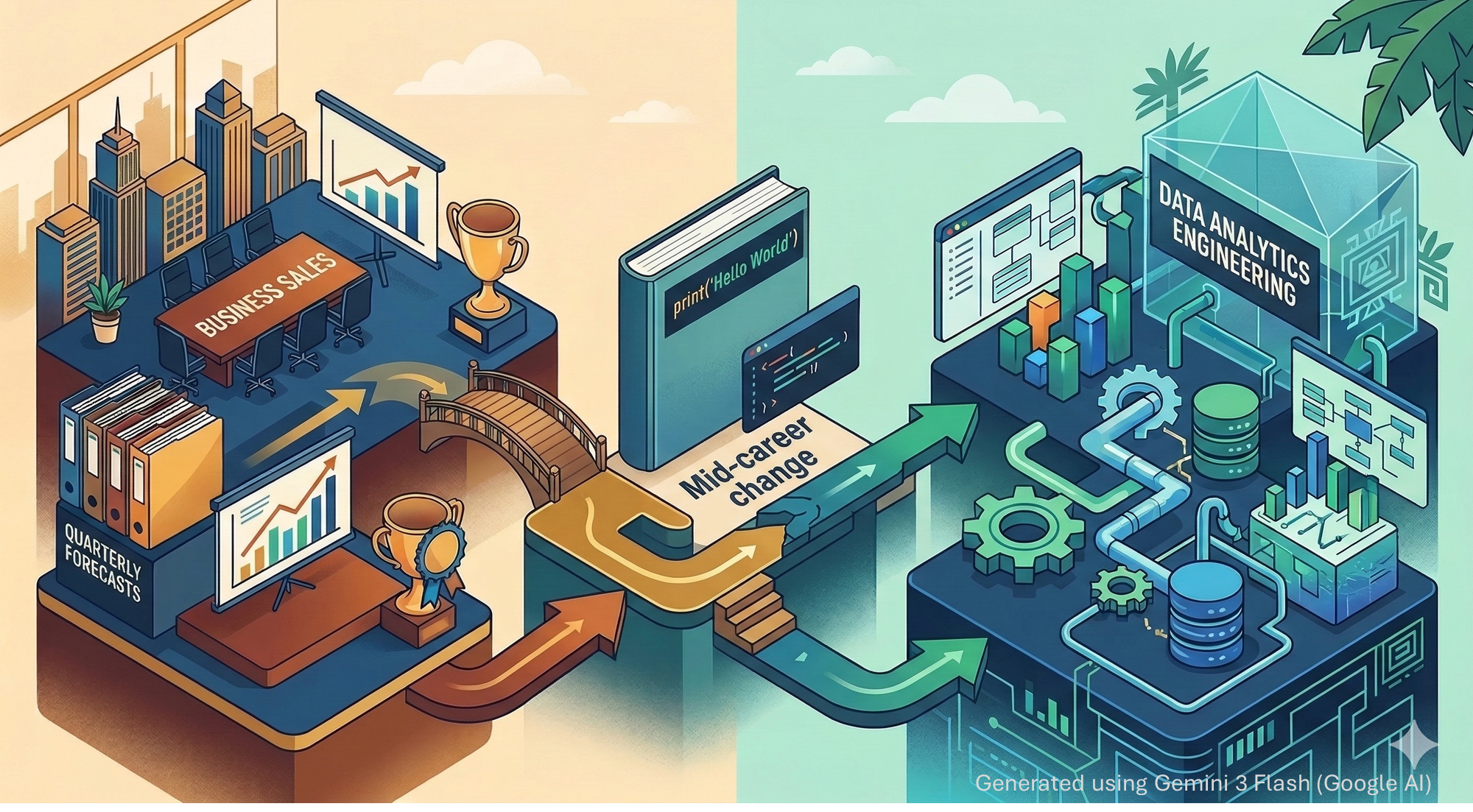
I spent fifteen years learning to speak fluent "enterprise sales"—the language of quarterly forecasts, stakeholder alignment, and the choreography of seven-figure deals. At Oracle, Collibra, and beyond, I was measured in quotas hit and forecasts met. I was comfortable with boardroom awards and the title, but I was increasingly restless for a reason I couldn't quite name—until I could.
I was selling the future of AI and data orchestration when I wanted to be the one building it. It was time for a career change. What I didn't expect was how much of what I already knew would transfer — or that my instinct for creative problem-solving would eventually land me in the Yucatán.
Committing to My Career Change
Deciding to leave a successful career is an exercise in ego demolition. You have to be willing to be bad at something again. Despite the unknowns, and the fears they inspired, I chose to become a beginner by making a career change to data engineering.
The first line of code I ever wrote was print("Hello World"). I stared at the terminal, half-expecting it to be harder than this. It spoke English. I hadn't expected Python to feel like just another dialect to acquire. But there it was: a new grammar to learn, and the familiar thrill of fluency just out of reach.
I had spent over a decade in an industry built on persuasion—crafting stories that would move people toward a decision. I was good at it. And yet, I was increasingly drawn to a different kind of truth-telling: one where the data speaks for itself, without an agenda, without a predetermined outcome. That's what pulled me toward data analytics engineering. Not away from what I'd built, but toward something I couldn't yet build.
Finding the Right Data Analytics Engineering Program
When I started researching the best grad schools for data analytics engineering, I wasn't looking for prestige—I was looking for a bridge. I needed a curriculum that wouldn't ask me to erase my decade of business experience, but would help me translate it into something I could actually build.
What caught my attention about Northeastern Online's M.S. in Data Analytics Engineering was that it refused to make me choose a silo. Most graduate engineering programs force you into one lane: you're either a data analyst interpreting trends, a data scientist building predictive models, or a data engineer building infrastructure.
I wanted the hybrid path—the "analyst who codes" role that dbt Labs famously identified as the analytics engineer, and what’s become one of the most in-demand roles in the data world. I didn't want a fragment of the data world; I wanted to understand the entire lifecycle, from ingestion to insight.
Grad School Affordability: Making a Career Change without Compromising Quality
I wasn't in a position to drain my savings or take on six figures of student debt for a career gamble. Finding an affordable graduate program felt impossible until I realized the flexibility of Northeastern Online could become a strategy, not a compromise.
So I moved to Mexico. My rent in the Yucatán is a fraction of what it was in Boston. I took a role as an AI Data Trainer, evaluating large language model responses for accuracy and bias detection. It's not glamorous, but I'm paying for a degree in AI while getting paid to understand how AI fails. The irony isn't lost on me.
What I didn't expect was how the online format would expand, rather than limit, my experience. My cohort isn't a collection of people who couldn't make it to campus—it's a global classroom of professionals who are all making sacrifices to be here. Last week, I was on a 2 AM call working through Operations Research problem sets with classmates in China and California. We're debugging linear programming models across three time zones, all of us juggling coursework with jobs and lives that don't pause for midterms.
This isn't a lesser version of graduate school. It's a different kind of rigor—one that mirrors how global teams actually work.
But here's what I've learned: my "sales logic" and my "data logic" aren't as different as I feared... When I'm building a model or debugging a query, I'm still thinking about the stakeholder. I'm still asking: who needs this, and why?
Bridging the Career Change Gap: How Sales Leadership Translates to Data Engineering
People ask if navigating a career change to data engineering makes me feel like I'm starting from zero. The honest answer is: sometimes, yes.
There was a database normalization assignment last semester that made me feel genuinely stupid. I'd spent a decade explaining data governance solutions to Fortune 500 executives, and here I was, staring at a schema diagram I couldn't untangle. The imposter syndrome wasn't abstract—it was specific and humbling.
But here's what I've learned: my "sales logic" and my "data logic" aren't as different as I feared. Managing a high-performance sales pipeline isn't that different from managing a data pipeline. Both require understanding bottlenecks, optimizing flow, and knowing which outputs actually matter. When I'm building a model or debugging a query, I'm still thinking about the stakeholder. I'm still asking: who needs this, and why?
Beyond the Classroom: Experiential Learning in Action
Studying at Northeastern University means experiential learning is built into everything. My capstone project—a Career Intelligence System that uses semantic matching to track job applications—started as an extension of my Database Management coursework with MySQL and MongoDB. It's not a class exercise I'll forget after grading; it's a production tool I actually use to manage my own job search.
As a Graduate Student Ambassador, I'm now designing a model to analyze engagement patterns in our Slack community for current students. Remote learning can be isolating. If the data can flag someone who's gone quiet, who's missing deadlines, who's slowly disengaging, we can reach out before they disappear.
I'm not learning about data pipelines in the abstract. I'm building them to solve problems I can see right in front of me.
The ROI of Starting Over: Why This Pivot Matters
What I didn't expect was how much the theory would change the way I see the world. Unsupervised learning models—the ones that find patterns in raw, unstructured data without being told what to look for—blow my mind. There's no human hand on the scale. No labels. No manipulation. The model just listens to what the data actually says.
Now I'm learning to build systems that don't start with a conclusion. No agenda. No predetermined outcome. Just the raw, unstructured signal—and the discipline to let it speak. I’ve built a professional portfolio of production-ready products and started writing original thought pieces to contribute to the larger industry conversation.
The job search is next. And for the first time, I know exactly what I'm looking for — because I finally know what I can build.

Ready to start your own pivot? Your background doesn't have to be traditional.
The Fast App is a straightforward alternative to the traditional admissions process — ideal for career changers, working professionals, and anyone who wants a simpler way to get started. Rather than going through a lengthy application process upfront, the Fast App lets you get started with coursework and prove your readiness on your own terms.
 Rosalina Torres is an M.S. in Data Analytics Engineering candidate at Northeastern University and a Graduate Student Ambassador for the College of Engineering. With over 15 years of enterprise technology experience at companies including EMC, Oracle, Zerto and Collibra — where she drove multi-million dollar revenue growth and built strategic partnerships with Fortune 500 organizations — she brings a rare combination of business leadership and emerging technical depth to the field of ML/AI engineering. Her work bridges the gap between data science and real-world business impact, translating complex machine learning systems into decisions that matter. When she’s not building ML pipelines, you’ll find her traveling the world with her camera — from photography tours in India to the cultural landscapes of the Yucatán. You can find Rosalina on LinkedIn, GitHub, and her website.